
icoone guide
icoone® Room, Staffing and Scheduling: A Setup Guide
Room layout for two-hand application, one therapist per room, scheduling 4–8 sessions a day, body suits, and ICO-ONE retail with the $58,000 Microfacial.
By Arty Perlov, DNA Distribution · September 2, 2026 · 8 min read
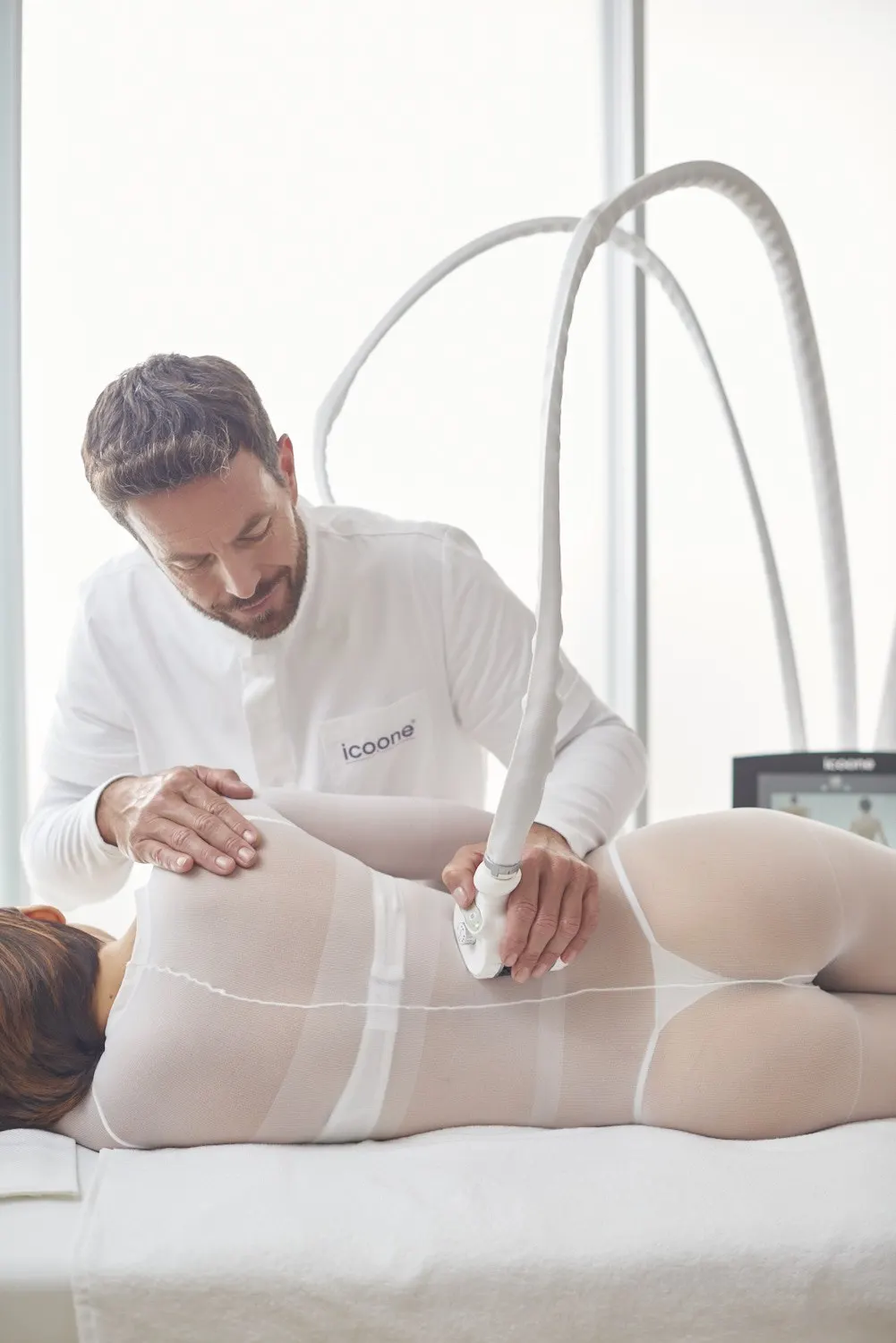
An icoone® room needs three things: floor space for two-hand work, one trained therapist, and a calendar built for series rather than singles. Get those right and one device sustains four to six sessions a day with body suits as the only consumable. This guide covers layout, staffing, scheduling and the retail attach.
What does the room actually need?
Space to walk both sides of the table. Two-hand symmetrical application is exclusive to icoone® — the therapist works both sides of the client at once with paired Robotwins handpieces and moves around the table rather than staying at one hip. A room already sized for manual massage is the right footprint; a narrow facial bay is not, unless you are running a face-only Microfacial room.
Beyond floor space, decide four things before installation day, which is included with every full-price device:
Console home position. Where the unit parks between clients, within easy reach of the handpieces from either side of the table.
Handpiece storage. So nothing is lifted across the client mid-session. Eleven handpieces on body configurations — 1 Robosolo, 2 Robotwins, 2 Robomini, 1 Robomicro with 6 attachments — need a home, not a shelf.
Body suit flow. Where clean suits are stocked and where used ones go. This is your hygiene protocol made physical.
Lighting. Workable for a face finish as well as a body pass, because a 10-minute Focus block on the face is one of the easiest upsells on the menu.
Power and siting specifics come from the manufacturer’s installation documentation and your installer — settle them during pre-delivery rather than guessing from a blog post.
How many staff, and who needs training?
One trained therapist per room per session. Two therapists share one device comfortably across a full six-day week, and a third only becomes necessary when you are consistently filling seven and eight daily slots, at which point the honest answer is a second room rather than a longer day.
Train the front desk as well as the therapists. The person booking has to describe the session accurately — robotic Roboderm® microstimulation, up to 21,600 microstimulations a minute, two hands at once, non-thermal, no downtime, 40 to 60 minutes — and has to book a series rather than a single, because i-Tech’s protocol structure runs two to three sessions a week. Training is included with every full-price device and covers handpieces, the programme library, Grip 1/2/3 modes, consultation and the hygiene protocol; see training and the team onboarding guide.
How do I build the schedule?
Start from the session structure: a 20-minute Base full-body pass plus one or two 10-minute Focus blocks, wrapped in consultation and turnover. That is a 60-minute booking slot, comfortably.
| Daily load | Slot pattern | What it demands |
|---|---|---|
| 4 sessions/day | 60-min slots, one therapist, part day | Realistic month one, launch phase |
| 6 sessions/day | 60-min slots, one therapist, full day | The sustained target for a single room |
| 8 sessions/day | 45–60-min slots, two therapists sharing | Peak days, promotions, open-house weeks |
Two scheduling rules do most of the work. First, book the next appointment before the client leaves the room — the series is the product, the single session is a trial. Second, protect recurring slots: a client on a two-a-week cadence should own the same two slots each week, which turns your calendar from a queue into a subscription.
i-Tech’s named protocols make this easy to publish, because each carries an explicit duration: Instant Well Being 20’, Time Stop Face 30’, Sweet Dreams 30’, Detox Express 40’, Jet Lag Recover 40’, Immuno Stimulation 50’, Relaxing Retreat 50’, Dynamic Skin Reactivation 50’, Body Glow 60’, Perfect Shape 60’, Eating Enjoy 70’. These are i-Tech protocol names your menu can license. Map each to a slot length in your booking software and the schedule builds itself. More on structure in the session planning guide.
What does the room consume?
Body sessions use a client body suit. That is the consumable, and it doubles as the hygiene layer. There are no tips, cartridges or applicators to replace on any body configuration, and no cartridges or disposables to replace on the Microfacial.
That single fact deserves a line in your business plan. On a device that bills per-treatment consumables, six sessions a day across 26 operating days can quietly remove more than a monthly equipment payment from your gross before you have paid anyone. Here, your variable cost per session is a suit and a therapist hour, which is what makes series pricing and package discounts viable. Sessions retail at $150–$350 per i-Tech.
Can the room generate retail?
With the Microfacial, yes. The ICO-ONE skincare line is used in-cabin during the session and sold as a home line at the desk, so one appointment produces service revenue and retail revenue without extra chair time. Face-only across seven zones — face, neck, décolleté, forehead, eye contour, lips and hands — with 8 actions, 22 programmes, 21 face protocols and 17 handpieces and applicators, at $58,000, ≈ $1,269/mo (Founders’ 25: $50,000, ≈ $1,095/mo). Practices already running a body icoone® often add it as a dedicated second room. Face menu detail in the facial session guide.
What does the device itself cost to put in the room?
| Model | Price | ≈ monthly (60 mo, $0 down, qualified) |
|---|---|---|
| icoone® Microfacial | $58,000 | ≈ $1,269/mo |
| icoone® Beauty | $79,000 | ≈ $1,730/mo |
| icoone® Laser Beauty | $85,000 | ≈ $1,860/mo |
| icoone® Medical | $87,000 | ≈ $1,904/mo |
| icoone® Laser-Med | $89,000 | ≈ $1,948/mo |
Subject to applicant and provider approval. Illustratively, five sessions a day at $250 across 26 operating days is $32,500 of billings against a ≈ $1,730 payment on an icoone® Beauty — planning arithmetic, not a forecast. Detail on icoone® cost, financing and the ROI guide.
On scope, so the room’s marketing stays clean: only icoone® Laser Beauty (510(k) K182453) and Laser-Med (510(k) K211272) carry FDA clearance, for four labeled indications — relief of minor muscle aches and pain; relief of muscle spasms; temporary improvement of local blood circulation; temporary reduction in the appearance of cellulite. Other configurations are cosmetic aesthetic. All icoone® devices are CE marked and ISO 13485.
What fills the calendar in month one?
The 90-Day Launch Program: $10,000 program value, fully managed marketing plus up to $2,500 of ad spend, running from marketing go-live until 30 booked paying clients or 90 days, whichever comes first, on full-price device purchases with Launch Playbook participation. Plus open-house support — with fewer than 100 icoone® devices installed in the United States, “the only one in the city” is often literally true.
Next: the icoone® hub, the aesthetic range, the drainage menu or DNA Distribution for territory.
Questions buyers ask
How big does an icoone® room need to be?
+
Large enough for a treatment table with walkable clearance on both long sides plus the console within reach. Two-hand symmetrical application means the therapist moves around the client rather than staying at one hip, so a room already sized for manual massage is the right starting point.
How many people does an icoone® need?
+
One trained therapist per room per session. Two therapists share one device comfortably across a six-day week. The front desk needs training too — they book series, not singles, and the session description has to be accurate.
How many sessions a day can one device run?
+
Four to eight, depending on slot length. A 40-minute Base-plus-Focus structure fits a 60-minute booking slot with consultation and turnover; most operators plan four to six sustained and treat eight as a peak day.
What consumables does the room need?
+
Client body suits for body sessions — that is the hygiene layer, and there are no tips, cartridges or applicators to replace. The Microfacial has no cartridges or disposables to replace, and the ICO-ONE skincare line used in-cabin is also sold as retail.
Can the room sell retail?
+
With the icoone® Microfacial, yes. The ICO-ONE skincare line runs in-cabin during the session and as a home line at the desk, so the same appointment produces service revenue and retail revenue without additional chair time.
90-Day Launch Program
Pay full price — we fund your first 90 days of ads and marketing.
$10,000 program value, on us (managed marketing + up to $2,500 ad spend).
*Full-price device purchases only; not combinable with promotions, discounts, or demo units. Includes fully managed marketing and an ad budget of up to $2,500 across 90 days. Program runs from marketing go-live until 30 booked paying clients or 90 days, whichever comes first. Requires Launch Playbook participation (our pricing, creatives, funnel, same-day lead response).
Related guides
How an icoone® Session Works: Base, Focus and Room Setup
A 20-minute Base full-body pass plus 10-minute Focus programs inside a 40–60-minute slot, run 2–3× a week — plus the room layout two-hand application needs.
icoone® Facial Sessions: Robomicro, Robomini, Microfacial
The seven-item icoone® face menu, the Microfacial's 17 handpieces, 8 actions and 7 zones, and sessions retailing at $150–$350 per i-Tech.
Building a Lymphatic-Drainage Menu with icoone®
Programs, session lengths, staffing and illustrative menu pricing of $150–$350 for an icoone® drainage menu, built on 24 programmes and 11 handpieces from $79,000.